You read a page of notes and everything looks familiar. Then you close the notebook and struggle to explain the main idea.
That gap is easy to miss during revision. Looking at an explanation gives you information that an exam question may expect you to produce independently.
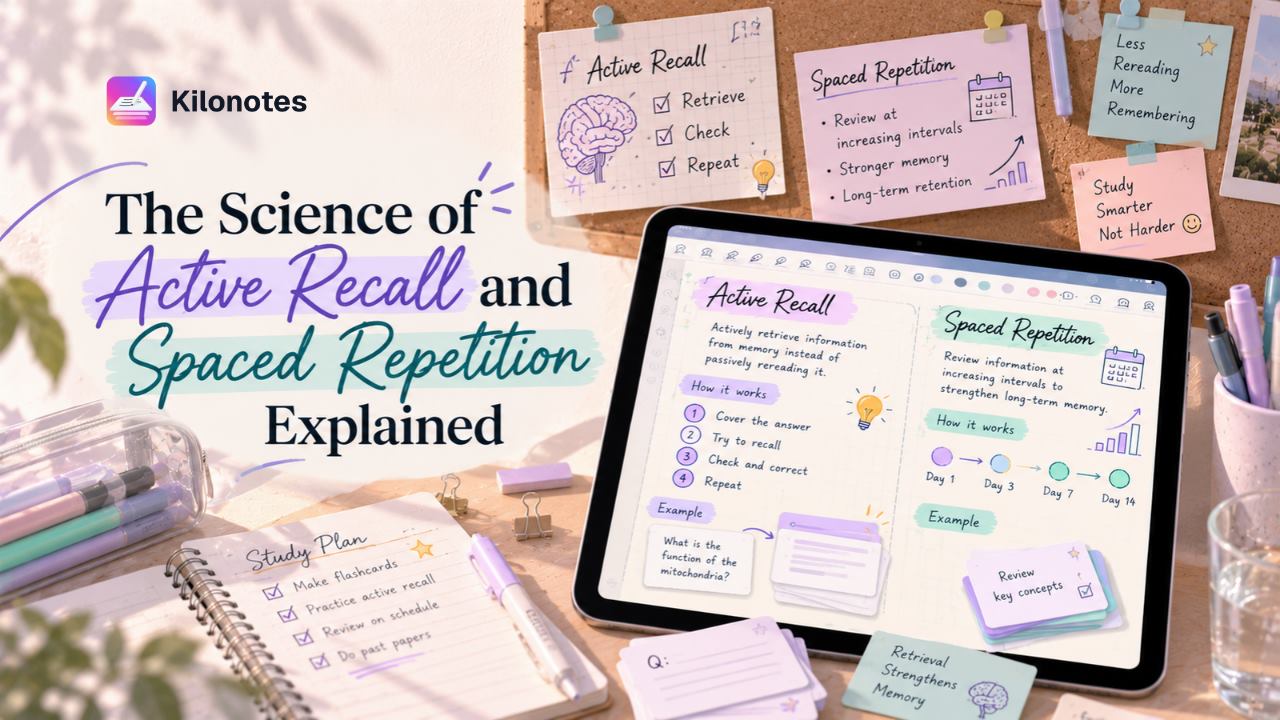
Active recall and spaced repetition help you build that independence. One changes what you do during a study session. The other changes when you return to the material.
What is active recall?
Active recall means attempting to retrieve information before checking the answer.
You might explain a concept aloud, label a blank diagram, solve a problem, or write an essay plan from memory. The important part is making a real attempt while the answer is out of view.
In experiments with prose passages, Roediger and Karpicke found that retrieval practice produced better retention on delayed tests than repeated study, even though repeated study increased confidence. Roediger and Karpicke, 2006.¹
That does not mean reading is unnecessary. You still need to encounter and understand the material. Retrieval gives you a way to practise using it and identify gaps.
What is spaced repetition?
Spaced repetition means revisiting material across separate sessions.
Instead of giving a topic one long evening and leaving it until the exam, return to it several times. Each session provides another opportunity to retrieve, check, and strengthen what you know.
A major review of ten learning techniques rated practice testing and distributed practice as high utility across a range of learners and learning tasks. Dunlosky and colleagues, 2013.²
There is no single review timetable that suits every topic. Difficulty, your current knowledge, and the time until the exam all matter.
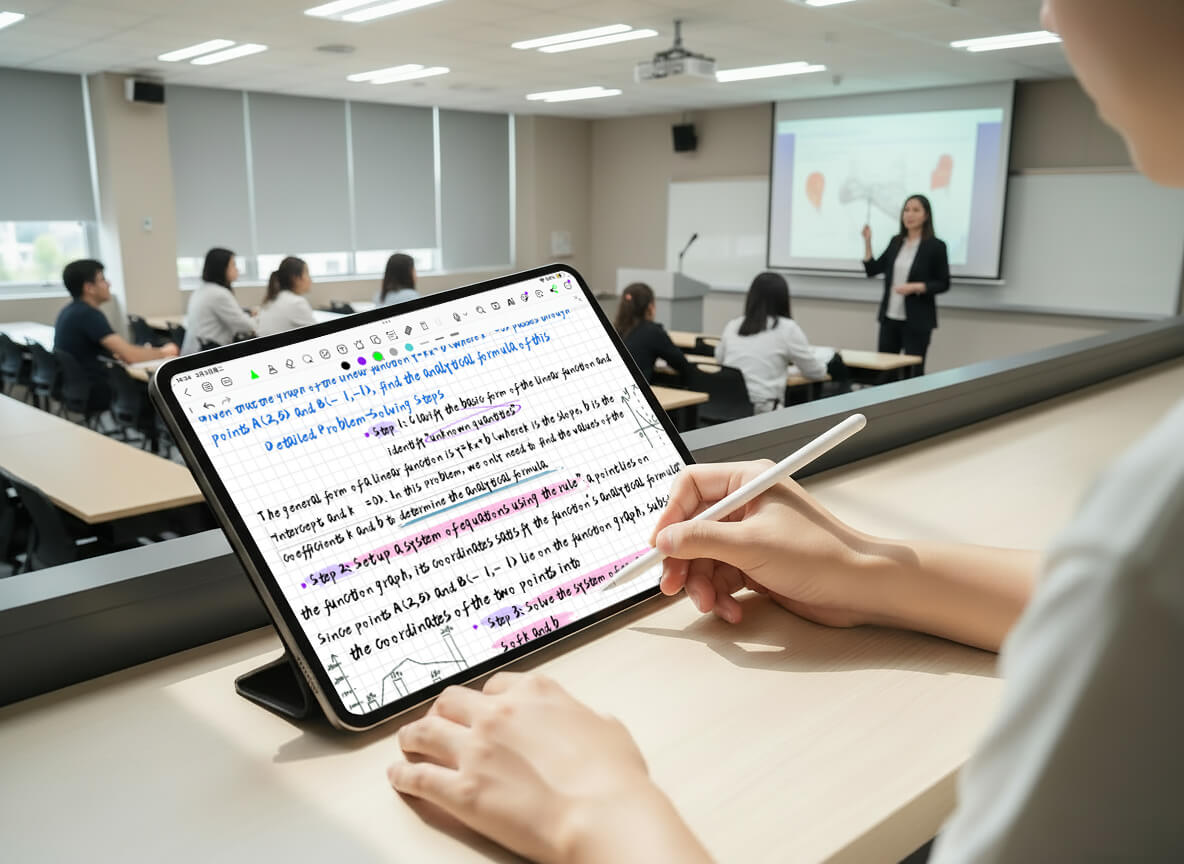
Build a repeatable session
Start with one learning objective and a small set of questions.
Try answering without your notes. Write enough to make your reasoning visible; “I know this” is difficult to evaluate.
Then check your answers against reliable course material. Correct mistakes and explain why the original answer was incomplete or wrong.
Finally, record what should happen next. A weak answer may need another explanation and an earlier review. A confident, accurate answer can be revisited after a longer gap.
For example, you might review a new topic the next day, a few days later, and the following week. Treat that as an adjustable starting point.
Match the practice to the exam
Definitions are useful, but they may only be part of what your assessment requires.
For mathematics, solve unfamiliar problems and explain your method. For essay subjects, build arguments from a prompt. For diagram-heavy material, draw and label from memory.
Include questions that ask when a rule applies and when it does not. This helps reveal whether you understand the limits of an idea.

Keep the record simple
Use three labels: “independent,” “partial,” and “needs work.” Add a next-review date and one sentence describing the difficulty.
Your notes can then guide the next session instead of becoming a growing pile of material to reread.
Kilonotes’ AI tools can generate practice questions from notes. Check generated questions and answers against your course sources, then attempt the questions before revealing the answers. Kilonotes AI study tools.³
Start with one lecture today. Write five questions, answer them with the notes closed, and use the results to plan your next review.
Footnotes
¹ Source: Roediger, H. L., & Karpicke, J. D. (2006). “Test-Enhanced Learning: Taking Memory Tests Improves Long-Term Retention.” Psychological Science, 17(3), 249–255. https://www.psychologicalscience.org/journals/psychological-science/j.1467-9280.2006.01693.x/
² Source: Dunlosky, J., Rawson, K. A., Marsh, E. J., Nathan, M. J., & Willingham, D. T. (2013). “Improving Students’ Learning With Effective Learning Techniques: Promising Directions From Cognitive and Educational Psychology.” Psychological Science in the Public Interest, 14(1), 4–58. https://www.psychologicalscience.org/publications/journals/pspi/learning-techniques.html
³ Source: Kilonotes. “AI Smart Assistant.” Accessed 21 October 2026. https://www.kilonotesapp.com/en/ai