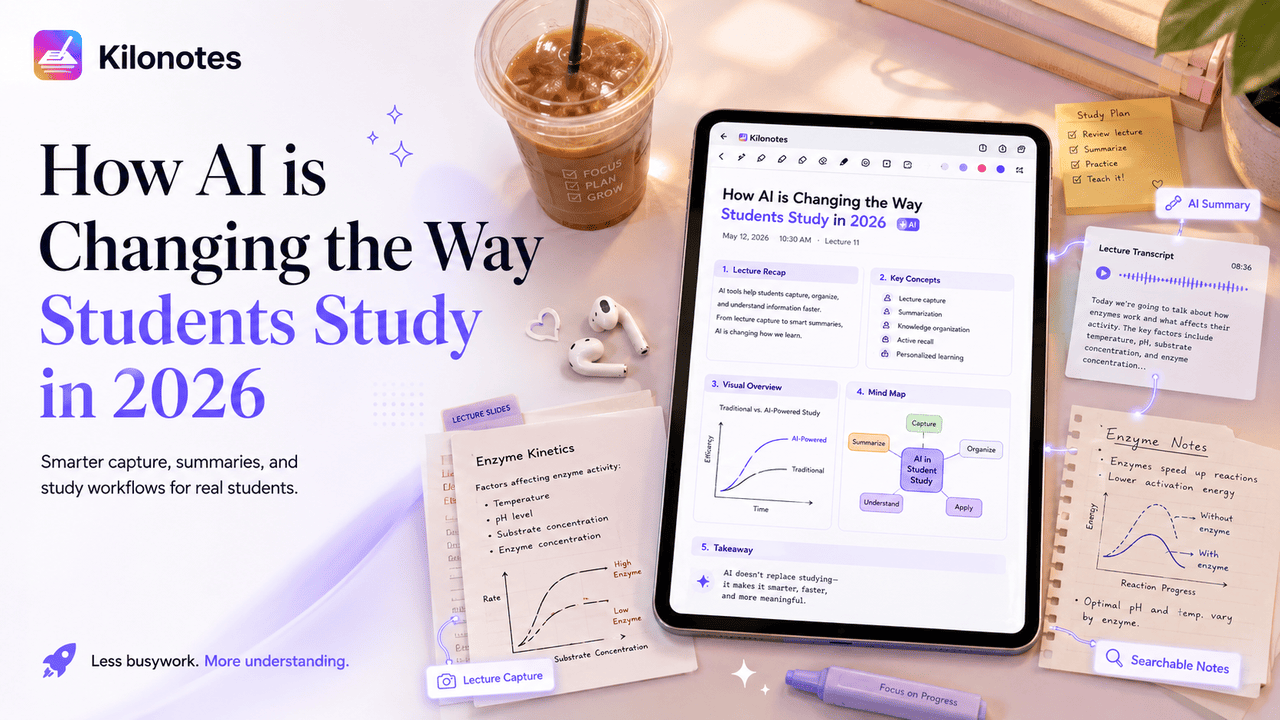
The real problem AI solves: collection vs. comprehension
Here's the uncomfortable truth about traditional note-taking. Most students are excellent collectors of information and poor processors of it. You leave a lecture with four pages of notes and a vague sense that you "have it written down somewhere," but the act of writing things down is not the same as learning them.
Cognitive science is blunt about this. Long-term memory is built through active recall and retrieval practice — the effort of pulling information back out of your head — not through passively re-reading or transcribing it.¹ The student who copies a slide word-for-word tends to remember less than the student who reframes that same idea into their own words, because verbatim transcription encourages shallow processing rather than real understanding.²
The trouble is that this kind of reframing takes time, and time is the one resource students never have enough of. So the genuinely valuable work — summarizing, connecting concepts, building revision materials — gets skipped.
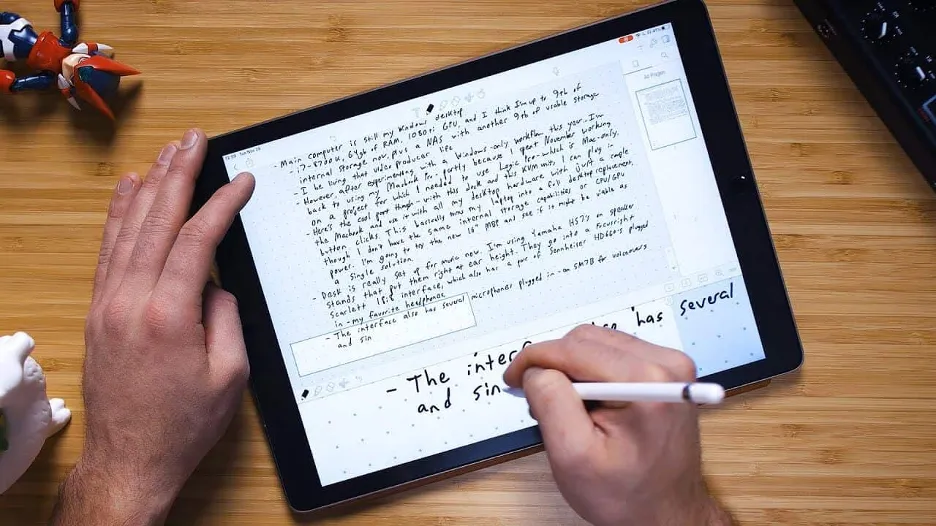
This is where AI changes the equation. By automating the mechanical parts of studying (transcribing, condensing, reformatting, digitizing), AI hands students back the hours they used to lose to busywork and lets them spend those hours on the active learning that actually moves knowledge into long-term memory.
If you haven't yet settled on a note-taking system to build on, it's worth pairing this guide with our Ultimate Guide to Note-Taking Methods for College Students — AI works best layered on top of a method that already suits how you think.
The four categories of AI study tools
The AI study tools landscape can feel overwhelming, but almost everything falls into a handful of practical categories.
1. Transcription and lecture capture
AI can now listen to an hour-long lecture and produce an accurate, time-stamped transcript in real time. Instead of choosing between listening and writing, you can stay fully present in class and let the tool capture the audio. Afterward, you have a searchable record of everything that was said — no more "wait, what did the professor mention about the exam?"
If you want to go deeper on this specific use case, see our breakdown of Can AI Summarize Lectures? The Best Study Tools for Students.
2. Summarization and key-point extraction
Raw transcripts and dense PDF readings are still too long to study from. AI summarizers condense a 5,000-word lecture or a 40-slide deck into a tight set of key points, outlines, or structured summaries. The best tools don't just shorten text — they identify what's important, surfacing the concepts most likely to appear on an exam.
3. Visual organization: mind maps and outlines
One of the most powerful shifts is AI's ability to turn linear notes into visual structures. Generative AI can take a wall of text and automatically produce a mind map or hierarchical outline, exposing the relationships between concepts that are invisible in a flat list. This plays to a well-documented quirk of human memory — we recall images and visual structure far more reliably than plain text, an effect known as the pictorial superiority effect — so for visual learners especially, a mind map turns "information I have" into "information I understand."³
4. Digitization: handwriting to searchable text
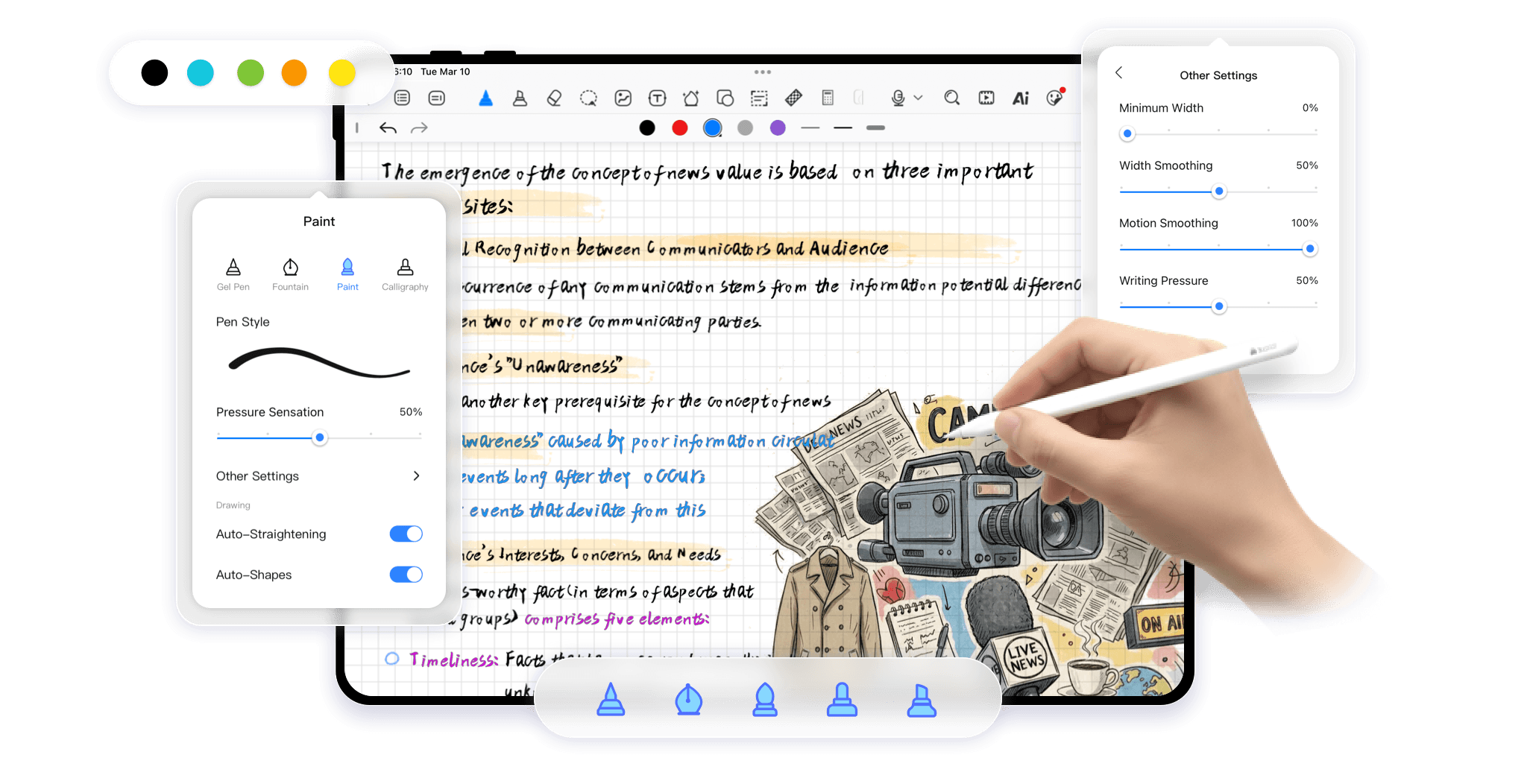
Handwritten notes are intuitive and memorable, but they trap your knowledge on paper. Modern OCR (optical character recognition) converts handwriting — even messy handwriting and complex math equations — into clean, editable, searchable text. Suddenly every note you've ever taken is findable in a second.
The productivity gains are real — and measurable
Students who adopt an AI-assisted workflow consistently report the same thing: their nightly study time drops dramatically. The hour spent recopying lecture notes shrinks to a few minutes of reviewing an AI-generated summary. The afternoon lost to making flashcards becomes an automatic export.
But the deeper gain isn't just speed — it's focus. When AI handles the low-value mechanical work, you have more cognitive energy for the high-value work: testing yourself, asking why, and connecting today's lecture to last week's. You study less and understand more.
The ethics question: using AI the right way
No serious conversation about AI for students is complete without addressing academic ethics, and this is where you need to be honest with yourself.
There is a bright line between AI that supports your learning and AI that replaces it. Using AI to transcribe a lecture you attended, summarize a reading you'll still study, or reorganize notes you took yourself — that's augmentation. You did the intellectual work; the AI did the clerical work.
Using AI to write your essay, answer your exam, or generate "knowledge" you never actually engage with — that's substitution, and it's both academically dishonest and self-defeating. You can't outsource comprehension. If the AI understands your material and you don't, you've gained a grade and lost an education.
A few principles keep you on the right side of the line:
- Use AI on your own inputs. Summarizing your lecture recording or your notes is fundamentally different from generating content from scratch.
- Always review the output. AI summaries can miss nuance or occasionally hallucinate. Treat them as a first draft, not gospel.
- Know your institution's policy. Rules around AI vary by university and even by professor. When in doubt, ask.
- Protect your privacy. Choose tools that are transparent about how they handle your data. Reputable study apps store your notes securely and don't use your private notebooks to train their models.
Used this way, AI doesn't make you a weaker student. It removes the friction that was stopping you from doing the deep work in the first place.
Where note-taking apps fit in
The most practical place these capabilities come together is inside a dedicated note-taking app. Rather than juggling a separate transcription service, a summarizer, an OCR tool, and a mind-mapping app, students are increasingly turning to all-in-one platforms that capture handwriting, record audio, annotate PDFs, and apply AI to all of it in a single workflow.
That integration matters. The value of AI compounds when every piece of your study material — handwriting, slides, recordings — lives in the same place and can be summarized, searched, and visualized together.
Apps like Kilonotes are built around exactly this idea: capture raw and messy in class, then let AI organize, summarize, and structure everything afterward.⁴ If you want to see how that works in practice, our Guide to Kilonotes AI: Transcribe, Summarize, and Ace Exams walks through the full workflow step by step.
The bottom line
AI isn't changing whether students study — it's changing what they spend their study time on. The mechanical work of collecting and recopying information is being automated away, and the time saved is being redirected toward the comprehension that actually earns the grade.
The students who thrive in 2026 won't be the ones who use AI to avoid thinking. They'll be the ones who use it to clear away everything that isn't thinking — and then do more of the real work than ever before.
Ready to study smarter? Start by understanding how AI can summarize your lectures, then see how Kilonotes brings it all together.
Footnotes
¹ Source: Jeffrey D. Karpicke and Henry L. Roediger III, "The Critical Importance of Retrieval for Learning". Science. https://www.science.org/doi/10.1126/science.1152408
² Source: Pam A. Mueller and Daniel M. Oppenheimer, "The Pen Is Mightier Than the Keyboard: Advantages of Longhand Over Laptop Note Taking". Psychological Science. https://journals.sagepub.com/doi/abs/10.1177/0956797614524581
³ Source: Douglas L. Nelson, U.S. Reed, and J.R. Walling, "Pictorial superiority effect". Journal of Experimental Psychology: Human Learning and Memory. https://www.researchgate.net/publication/22152101_Pictorial_superiority_effect
⁴ Source: Kilonotes, "Kilonotes — Handwriting Notes App with AI for Students". https://www.kilonotesapp.com/en