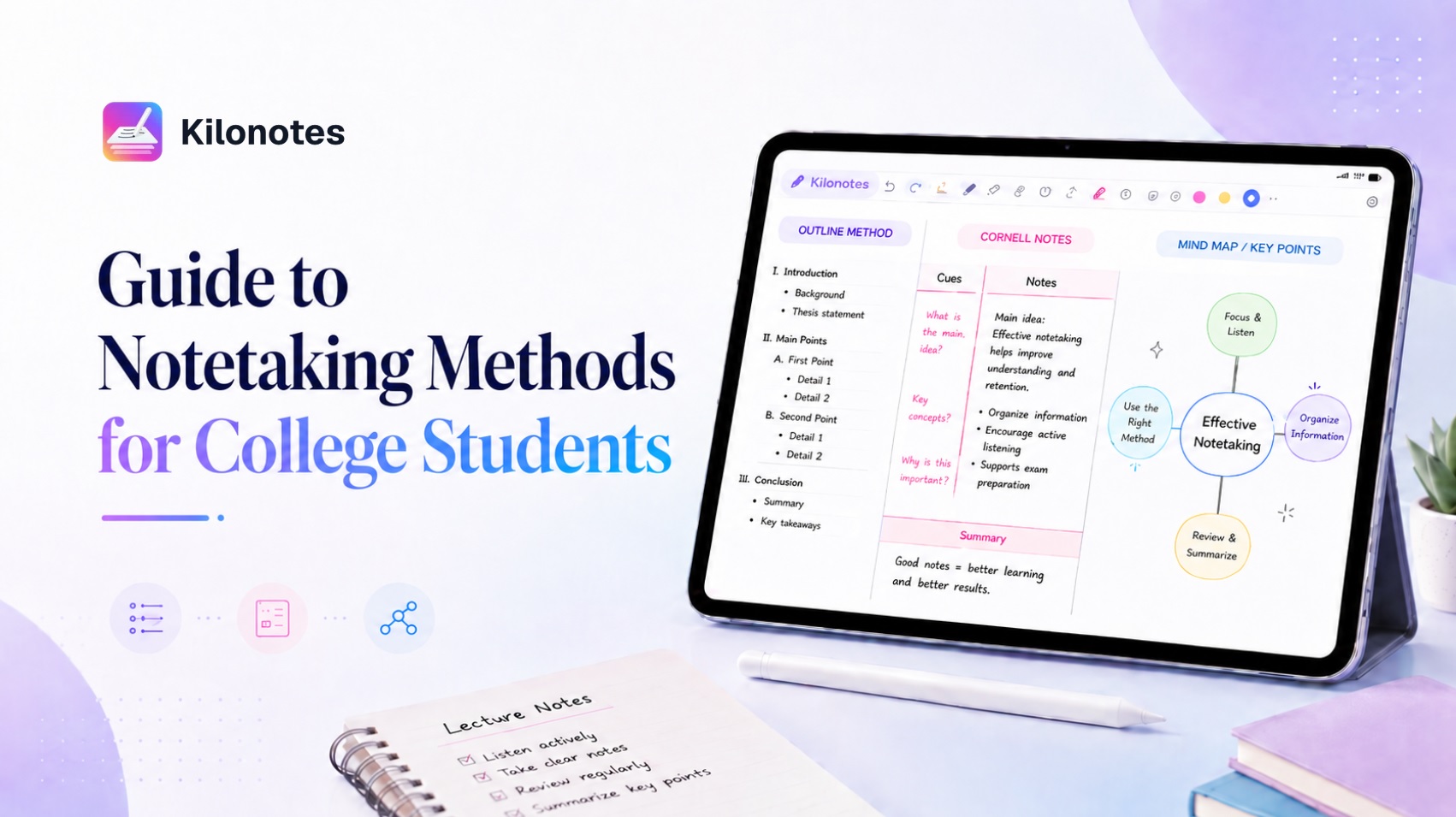
Transitioning to college often brings a harsh realization: the study habits that got you through high school might not cut it anymore. With fast-paced lectures, dense reading assignments, and a heavier cognitive load, finding the best way to take notes in college is essential for academic survival.
But note-taking isn’t just about frantically transcribing what your professor says. It is a critical cognitive process. By exploring proven note-taking methods, you can shift from passively recording information to actively processing it, allowing you to study smarter, not harder.
In this guide, we will break down the most popular frameworks and dive into cognitive psychology behind why these study techniques for students actually boost memory retention.
The Cognitive Psychology of Note-Taking
Before diving into the methods, it helps to understand why taking notes improves memory. Cognitive psychologists point to two main processes:
- The Encoding Hypothesis: The physical act of processing information and writing it down transforms the data in your brain. You aren't just hearing it; you are translating it into your own words, which builds stronger neural pathways.¹
- The External Storage Hypothesis: Your notes serve as an external hard drive. By organizing information logically, you reduce cognitive overload on your working memory, freeing your brain to grasp complex concepts.¹
Pro-Tip: The most effective note-taking happens when you synthesize information rather than write verbatim. Active listening combined with a structured method forces your brain to categorize and connect new knowledge immediately.
The Cornell Method: The Gold Standard for Retention
Developed at Cornell University in the 1950s by education professor Walter Pauk,² this method forces you to think critically about your notes right from the start.
How it works:
Divide your page into three sections:
- Notes Column (Right): The main body where you record the lecture.
- Cue Column (Left): After class, pull out main ideas, keywords, or questions that correspond to the notes on the right.
- Summary (Bottom): A brief 1-2 sentence summary of the entire page.
The Psychology Behind It:
The Cornell Method heavily relies on active recall and spaced repetition. By using the left column to quiz yourself later (covering the right side and answering the prompts on the left), you strengthen memory retrieval pathways. The summary section forces synthesis, which is a high-level cognitive function.
Curious how this compares to visual learning? Check out our deep dive: Cornell Notes vs. Mind Mapping: Which Note-Taking Style is Best?
The Outline Method: The King of Structure
This is the most intuitive and widely used method. It organizes information hierarchically, moving from broad topics to granular details.
How it works:
- Main Topic (Furthest to the left)
- Sub-topic (Indented)
- Supporting fact or detail (Indented further)
The Psychology Behind It:
The Outline Method leverages chunking, a psychological concept where the brain breaks down vast amounts of data into smaller, manageable "chunks."³ By visually grouping related concepts, your brain can easily map out the relationship between a parent concept and its supporting evidence.
Best for: Highly structured lectures and textbooks with clear chapters and headings.
Mind Mapping: The Visual Learner's Best Friend
For subjects that are conceptual rather than linear, mind mapping allows you to visually connect ideas.
How it works:
Start with your main concept in the center of the page. Draw branches outward to sub-topics, and smaller twigs extending from those to specific details.
The Psychology Behind It:
Mind mapping engages the Dual Coding Theory, which suggests that our brains process visual and verbal information through separate channels.⁴ By combining text with visual spatial organization, you encode the information twice, making it significantly easier to retrieve during an exam.
Best for: Brainstorming, essay planning, and subjects with complex, interconnected theories (like philosophy, literature, or sociology).
The Charting Method: The Data Organizer
When a lecture is heavy on facts, dates, and comparisons, standard notes can quickly become a messy wall of text.
How it works:
Create a table with categories across the top and items down the side. As the lecture progresses, fill in the corresponding boxes.
The Psychology Behind It:
Charting reduces cognitive load by providing a pre-existing mental scaffold.⁵ Instead of trying to figure out how pieces of data relate to one another on the fly, the matrix organizes it for you. This makes pattern recognition a key component of critical thinking much faster.
Best for: History (comparing eras), biology (comparing cell types), or any class requiring rote memorization of distinct categories.
Comparing the Methods at a Glance
| Note-Taking Method | Best Used For | Primary Cognitive Benefits |
|---|---|---|
| Cornell | Comprehensive studying and exam prep | Active recall and synthesis |
| Outline | Highly structured, linear lectures | Chunking and hierarchical organization |
| Mind Mapping | Interconnected ideas & visual subjects | Dual-coding and spatial memory |
| Charting | Heavy factual data & comparisons | Reducing cognitive load & pattern recognition |
Organizing Your Notes in the Digital Age
While the physical act of writing is great for encoding, digital tools offer unparalleled advantages for the external storage side of the psychological equation. Using tablets and note-taking apps allows you to combine these frameworks seamlessly. You can easily drag and drop outlines, draw mind maps in infinite canvas spaces, and search your handwriting for specific keywords.
To get the most out of your digital setup and ensure your files don't become a disorganized mess right before finals, learn How to Organize Your College Lectures with Kilonotes.
Final Thoughts
There is no single "perfect" way to take notes. The best approach is a hybrid one, like using the Outline Method during a fast-paced lecture, and later converting those concepts into a structured layout to reinforce the material. By understanding how your brain encodes and retrieves information, you can tailor these methods to fit your personal learning style and conquer your college semesters.
- Ditch the Manual Setup: You don't need to waste time drawing borders or formatting pages from scratch.
- The All-in-One Solution: Kilonotes streamlines this entire workflow by offering a massive variety of pre-made layouts including professionally designed Cornell notes templates, engineered to fit everyone's specific study needs.
- Accelerate Your Learning: Ready to upgrade your study routine? Explore the Kilonotes Template Collection today to find the perfect layout for your learning style and start studying smarter.

Footnotes
¹ Source: Pam A. Mueller and Daniel M. Oppenheimer, "The Pen Is Mightier Than the Keyboard: Advantages of Longhand Over Laptop Note Taking". https://journals.sagepub.com/doi/10.1177/0956797614524581
² Source: George A. Miller, "The magical number seven, plus or minus two: Some limits on our capacity for processing information". https://psycnet.apa.org/doi/10.1037/h0043158
³ Source: Allan Paivio, "Imagery and Verbal Processes". https://www.taylorfrancis.com/books/mono/10.4324/9781315798868/imagery-verbal-processes-paivio
⁴ Source: John Sweller, "Cognitive load during problem solving: Effects on learning". https://www.sciencedirect.com/science/article/pii/0364021388900237