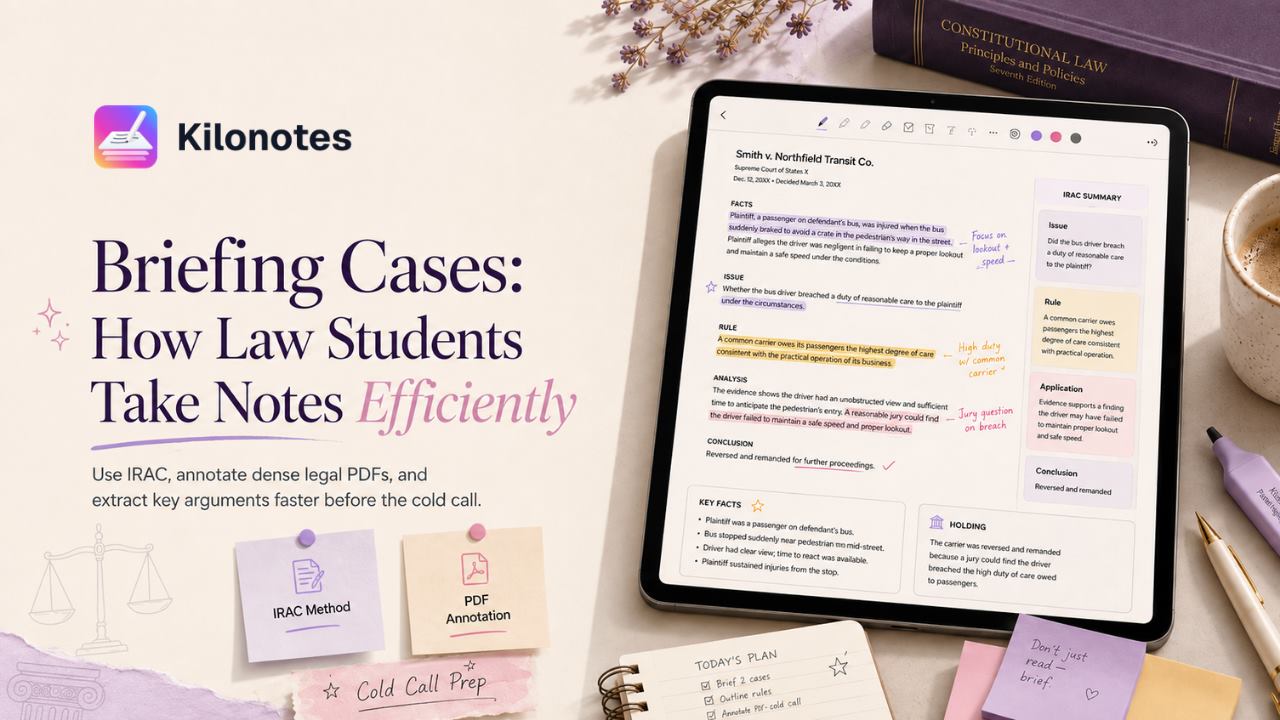
The first month of law school teaches you that reading is not the same as understanding. You'll read a thirty-page opinion carefully, highlight most of it, arrive at seminar, get asked what the holding was — and discover you can't say it in a sentence.
That gap is what case briefing exists to close. A brief isn't a summary of an opinion — it's a structured extraction, almost always built on the IRAC method, of the four things the opinion is actually doing. Done properly it takes fifteen minutes, produces half a page, and means you can answer a cold call without your stomach dropping.
This guide covers the IRAC structure, how to annotate dense judgments without drowning in them, and how to organise briefs so they're still useful during revision rather than only on the day.
Studying a high-volume programme generally? Our guide on how to survive your first year of medical school covers the time-management and retrieval systems that apply just as well to law.
What IRAC actually is
IRAC stands for Issue, Rule, Application, Conclusion. It's the standard analytical structure for legal reasoning, and it works as a briefing template because it mirrors what a court is doing when it decides a case.
Issue. The precise legal question before the court. Not "this is a contract case" — that's a topic. The issue is the disputed point, ideally phrased as a question: Does an advertisement constitute an offer capable of acceptance, or an invitation to treat?
Getting the issue narrow is the hardest part and the most valuable. A vague issue produces a useless brief.
Rule. The legal principle the court applies. Sometimes a statute, often a test drawn from precedent. Record it precisely, including its elements — a three-part test is three things, and you will be asked which one failed.
Application. How the court maps the rule onto these particular facts. This is the intellectual core of the opinion and the section students most often under-record, because it's the hardest to compress. It's also exactly what seminars interrogate.
Conclusion. What the court held, and for whom.
A useful discipline: if you can't state the issue and the holding in one sentence each, you haven't finished reading.
What to add beyond IRAC
Strict IRAC is the skeleton. Three additions make a brief genuinely useful later.
Material facts only. Not the full narrative — just the facts the outcome actually turned on. A good test: if changing a fact wouldn't change the result, leave it out.
Dissents and concurrences. Frequently where the interesting reasoning lives, and disproportionately likely to be raised in seminar. A line on what the dissent thought the majority got wrong is worth having.
Your own question. One line on what you didn't follow or found unconvincing. This is the part you'll actually want in revision, and it makes you a better contributor in class.

Annotating dense judgments without drowning
The reading volume is the real challenge. A week's reading can run to two hundred pages of tightly argued prose. Two things make it manageable.
Read the case twice, differently. First pass: fast, no marking, just working out the shape — who's suing whom, over what, and who won. Second pass: slow, annotating, now that you know where the argument is going. This is faster overall than one careful pass, because on a single read you don't know what matters until you've finished.
Use a fixed annotation vocabulary. Three or four marks, used consistently across every case:
One mark for the statement of the rule
One for the court's key reasoning step
One for material facts
One for anything you don't understand
Colour-coding beyond about four categories stops being a system and becomes decoration. The point is that in revision you can find the rule in a forty-page opinion in five seconds.
Annotate in the margin, not across the text. Judgments are dense; writing over them makes them unreadable. Keep your reasoning in the whitespace beside the passage it responds to.
If you're working on an Android tablet, our walkthrough on how to annotate PDFs on Android tablets with the S Pen covers the mechanics of handling heavy documents without lag.
Organising briefs so they survive to exams
Individual briefs are for seminars. Exams need something else, and the transition catches people out.
Group briefs by doctrine, not by week. Your course is delivered chronologically but examined thematically. At the end of each topic, collapse your individual briefs into a single doctrinal outline: here is the test, here are the cases that establish each element, here is where the boundary is contested.
Build the outline continuously. The synthesis is the study, not the preparation for study. Doing it weekly spreads the work and gives you repeated retrieval practice — which, along with distributed practice, is one of only two techniques a major review rated high-utility across subjects and learners.¹
Keep everything searchable. By April you'll want every case where a particular test was applied. If your briefs are handwritten and unsearchable, that's an afternoon of flipping. If they're searchable text, it's a query.
The cold call
Preparation for a cold call is not re-reading the case. It's being able to state, without notes:
The facts, in three sentences
The issue, as a question
The holding
The reasoning, in one step-by-step chain
If you can do those four, you're prepared — regardless of what you can't recall about paragraph 47. Rehearse them out loud once before class. Retrieving them from memory rather than reading them is both better preparation and better learning.²

Doing this efficiently
The workflow above involves annotating heavy PDFs, converting handwriting into searchable text, and synthesising many briefs into doctrinal outlines. Running that across three tools is where most students' systems break down.
Kilonotes handles the whole chain: import case opinions as PDFs and annotate them directly with a stylus, with AI extracting key points from the document; convert handwritten briefs into searchable text while keeping the original handwriting; and search across every notebook, so finding each case that applied a given test is one query.³ AI recap and outline generation help with the weekly synthesis step, turning a set of briefs into a structured doctrinal summary rather than a pile of separate documents.
Recording seminars is the other half — AI transcribes and summarises automatically, which is useful when a tutor's aside about how a test is really applied never appears in any reading.
Ready to brief faster? Download Kilonotes free and try it on this week's longest judgment.
Footnotes
¹ Source: John Dunlosky, Katherine A. Rawson, Elizabeth J. Marsh, Mitchell J. Nathan and Daniel T. Willingham, "Improving Students' Learning With Effective Learning Techniques: Promising Directions From Cognitive and Educational Psychology." Psychological Science in the Public Interest, 2013;14(1):4-58. https://journals.sagepub.com/doi/abs/10.1177/1529100612453266
² Source: Jeffrey D. Karpicke and Henry L. Roediger III, "The Critical Importance of Retrieval for Learning." Science, 2008;319(5865):966-968. https://www.science.org/doi/10.1126/science.1152408
³ Source: Kilonotes, "How to Convert Handwriting to Text Quickly and Accurately." https://www.kilonotesapp.com/en/blog/how-to-convert-handwriting-to-text