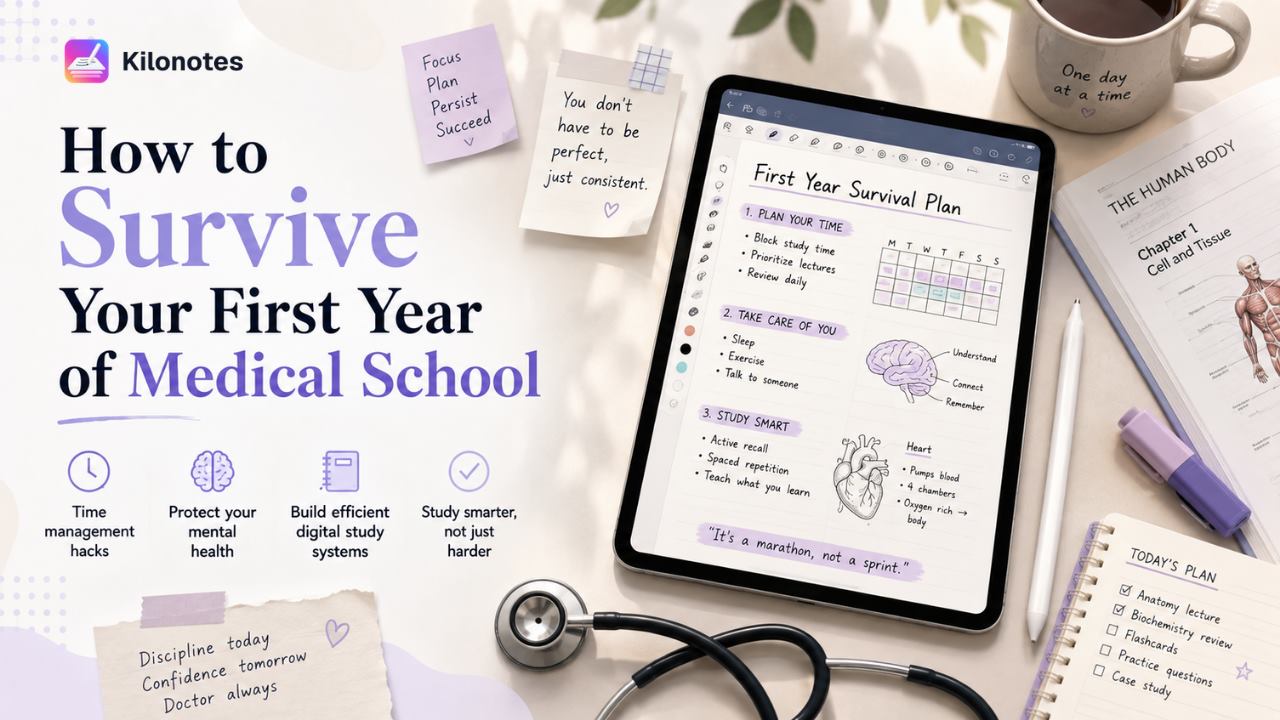
Every incoming medical student is told the same thing: it's like drinking from a firehose. It's an accurate metaphor and a useless one, because it describes the problem without suggesting what to do about it.
Here is the more useful framing. First year isn't hard because the material is conceptually difficult — most of it isn't, individually. It's hard because the volume arrives faster than any undergraduate study habit can process, and the strategies that got you into medical school are precisely the ones that will fail you in it. Re-reading lecture notes works fine for one module. It collapses entirely against forty lectures a week.
So this guide covers the three things that actually determine whether first year goes well: what you do with your time, what you do with your mind, and what you do with the information. In that order, because the third is where most advice starts and it's the least important of the three.
New to structured note-taking generally? Our ultimate guide to note-taking methods for college students covers the foundations this article builds on.
Stop trying to learn everything
The hardest adjustment is accepting that comprehensive mastery is no longer available to you. There is more material than there are hours, and no amount of discipline changes that arithmetic.
What replaces it is triage. Before each block, work out what is high-yield — what recurs, what the exam actually assesses, what underpins later material. Then deliberately let the rest be approximate. This feels irresponsible in September and obvious by March.
The students who struggle most in first year are rarely the least capable. They're often the most conscientious ones, still trying to know everything, discovering in week six that the strategy doesn't scale.
The study techniques that survive contact with volume
Decades of cognitive research converge on an uncomfortable finding: the techniques most students use are among the least effective available.
A landmark review assessed ten common study techniques and rated only two as high utility across learners, subjects and settings — practice testing and distributed practice. Re-reading and highlighting, by far the most popular methods, were both rated low utility.¹
That's the whole game, and the implications are worth stating bluntly.
Practice testing means retrieval, not recognition. Close the notes and try to reproduce the pathway from memory. The struggle is the mechanism — actively pulling information out consolidates it far more than putting it in again.²
Distributed practice means spacing, not cramming. The same total hours spread across a fortnight substantially outperform those hours in one weekend. This is why anatomy crammers pass the block exam and remember nothing by clinical years.
Highlighting is not studying. It feels productive because it involves your hands and produces a visible artefact. It changes retention very little.¹ If you highlight, treat it as marking what to convert into questions later — never as the study session itself.
The practical version: after each lecture, spend ten minutes turning it into questions rather than re-reading it. Then answer those questions three days later, a week later, and a month later.
If your blocks lean heavily on notation — biochemistry, physiology, medical statistics — the mechanics are different enough to need their own approach. Our guide on the best ways to organize STEM notes and math equations covers keeping formulas searchable.
Time management that accounts for being tired
Standard productivity advice assumes a rested person with discretionary hours. First year is not that.
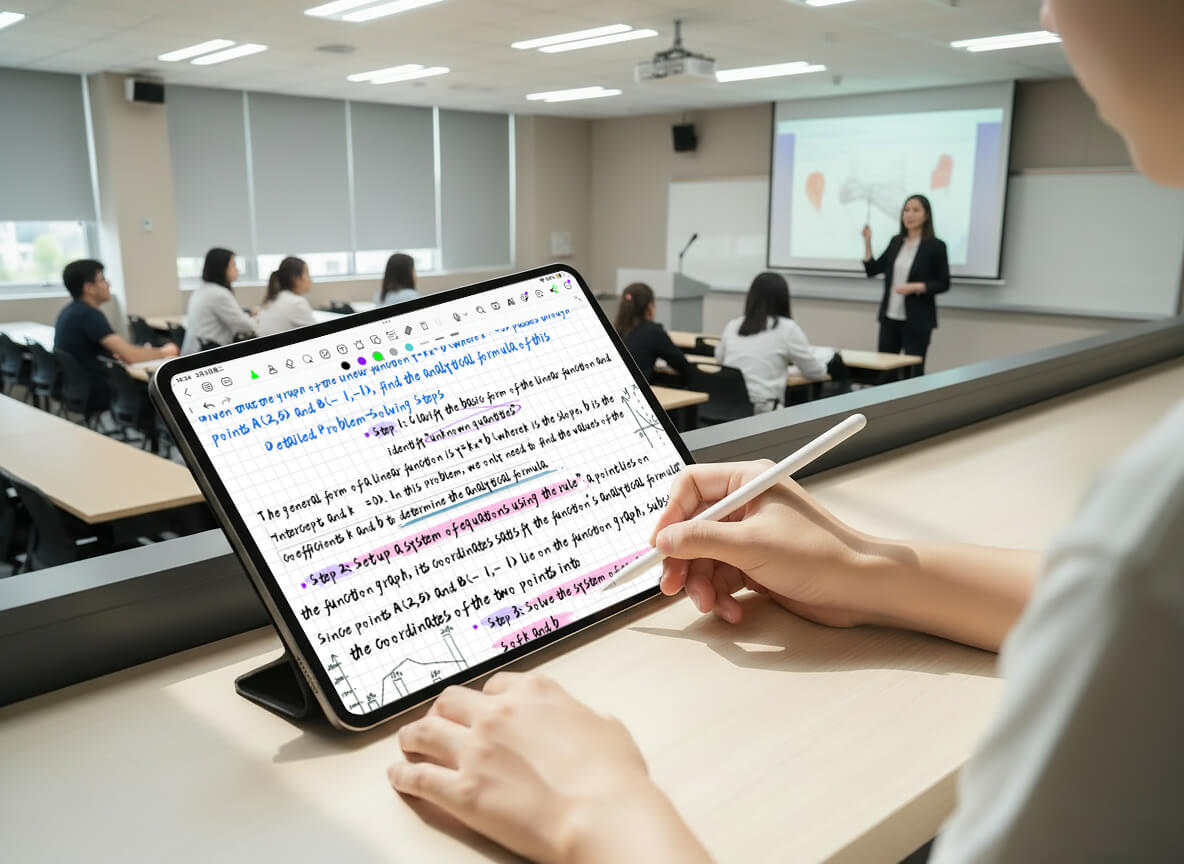
Protect the post-lecture window. The thirty minutes after a lecture, while context is still loaded, is worth two hours a week later. Use it to convert notes into questions, not to organise files.
Schedule the review, don't intend it. Spaced practice only works if the later sessions actually happen. Put them in a calendar as fixed commitments.
Choose a stopping time in advance. Open-ended study expands to fill the time available and returns diminish sharply after the first few hours. A student who stops at nine and sleeps outperforms one who stops at one and doesn't.
Batch your admin. Reorganising notebooks, tweaking templates and reformatting notes is procrastination that resembles work. Give it one slot a week.
Your mental health is not a soft topic
This section usually gets a paragraph about self-care. It deserves more, because the data is genuinely serious.
A systematic review and meta-analysis published in JAMA covering 195 studies across 47 countries found a pooled prevalence of depression or depressive symptoms among medical students of 27.2%. In a separately pooled subset, 11.1% screened positive for suicidal ideation. Among those who screened positive for depression, only 15.7% sought psychiatric treatment.³
Three things follow.
This is a structural feature of medical training, not a personal failing. More than a quarter of your cohort is experiencing it. If that includes you, you are not the exception who couldn't cope.
The treatment gap is the actionable part. The striking figure isn't the prevalence — it's that most affected students don't seek help. Find out now, while you're well, what your institution's counselling service is and how to reach it. Knowing the process in advance removes one barrier at the moment you're least able to navigate one.
Sleep is a study technique. Memory consolidation happens during sleep. Trading it for extra hours is not a neutral exchange — you are degrading the process you stayed up to serve.
Build a system that scales
The final piece is infrastructure, and it matters more in medicine than in almost any other degree because of one specific problem: retrieval across time.
In second year you will need something from a first-year lecture. If your notes are forty PDFs named Lecture12_final_v2, that information is functionally gone. The system that survives has three properties:
Everything in one place. Lectures, annotated slides, recordings and revision material in a single searchable archive — not scattered across four apps.
Everything searchable, including handwriting. This is the property that turns an archive into something you can actually use.
Everything dated and tagged by block. So "the lecture where they introduced the coagulation cascade" is a search, not an excavation.
Set this up in week one. Setting it up in March means migrating six months of chaos, which nobody does.
The tooling that makes this practical
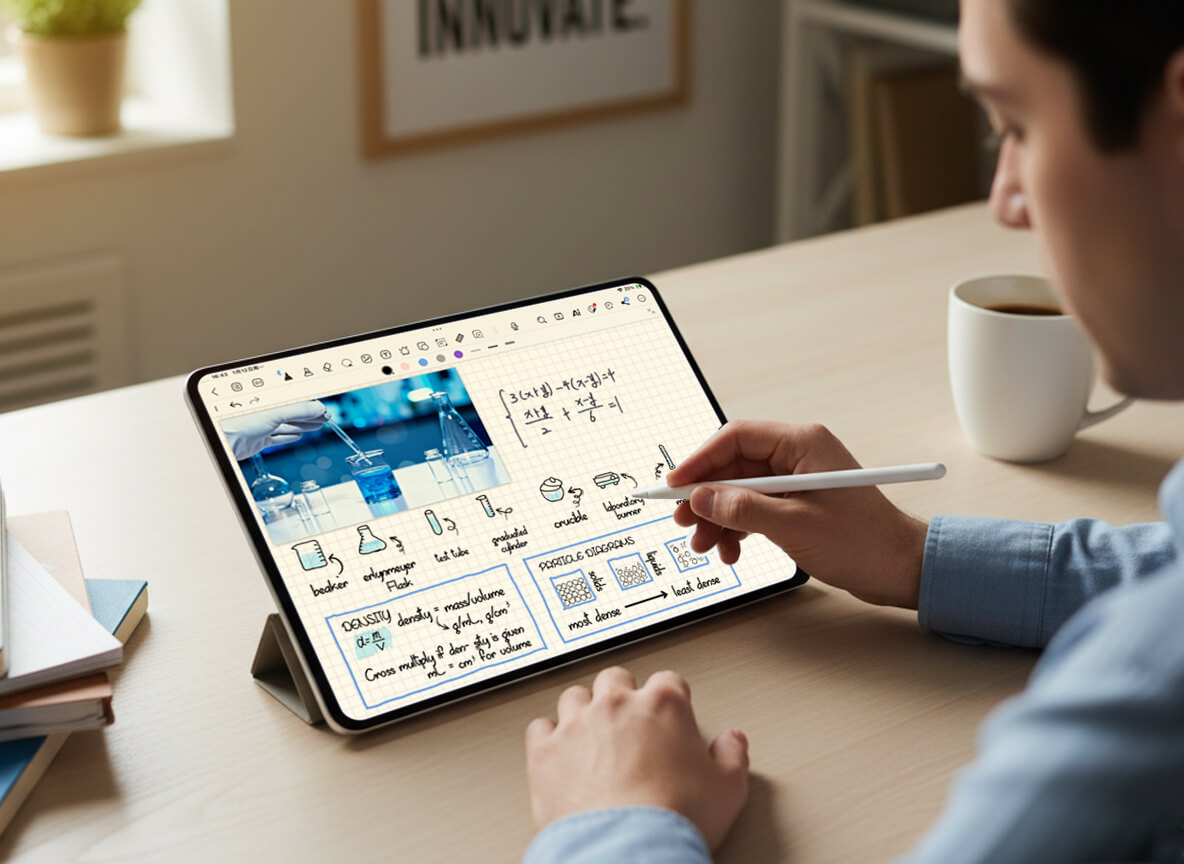
The system above is app-agnostic in principle. In practice it needs software that handles lecture capture, dense PDF annotation and cross-notebook search together, because gluing three tools into a pipeline is exactly the kind of maintenance you won't sustain during a heavy block.
Kilonotes is built for that shape of workload: record a lecture and get an AI recap of the key points, annotate slide decks and textbook PDFs directly with AI extracting the important material, and convert handwriting into searchable text, with the original handwriting kept alongside it.⁴ Everything is indexed across every notebook, so a first-year lecture stays findable in second year.
For how this plays out in medicine and law specifically, read why med and law students are switching to Kilonotes.
On a different high-volume degree? The same triage-and-retrieval system transfers — law students face an almost identical problem shape, and briefing cases with the IRAC method is the discipline-specific version of it. If you're still choosing hardware to run all this on, start with our guide to the best tablets for college students.
Starting first year soon? Download Kilonotes free and set up one notebook per block before week one.
Footnotes
¹ Source: John Dunlosky, Katherine A. Rawson, Elizabeth J. Marsh, Mitchell J. Nathan and Daniel T. Willingham, "Improving Students' Learning With Effective Learning Techniques: Promising Directions From Cognitive and Educational Psychology." Psychological Science in the Public Interest, 2013;14(1):4-58. https://journals.sagepub.com/doi/abs/10.1177/1529100612453266
² Source: Jeffrey D. Karpicke and Henry L. Roediger III, "The Critical Importance of Retrieval for Learning." Science, 2008;319(5865):966-968. https://www.science.org/doi/10.1126/science.1152408
³ Source: Lisa S. Rotenstein et al., "Prevalence of Depression, Depressive Symptoms, and Suicidal Ideation Among Medical Students: A Systematic Review and Meta-Analysis." JAMA, 2016;316(21):2214-2236. https://jamanetwork.com/journals/jama/fullarticle/2589340
⁴ Source: Kilonotes, "How to Convert Handwriting to Text Quickly and Accurately." https://www.kilonotesapp.com/en/blog/how-to-convert-handwriting-to-text