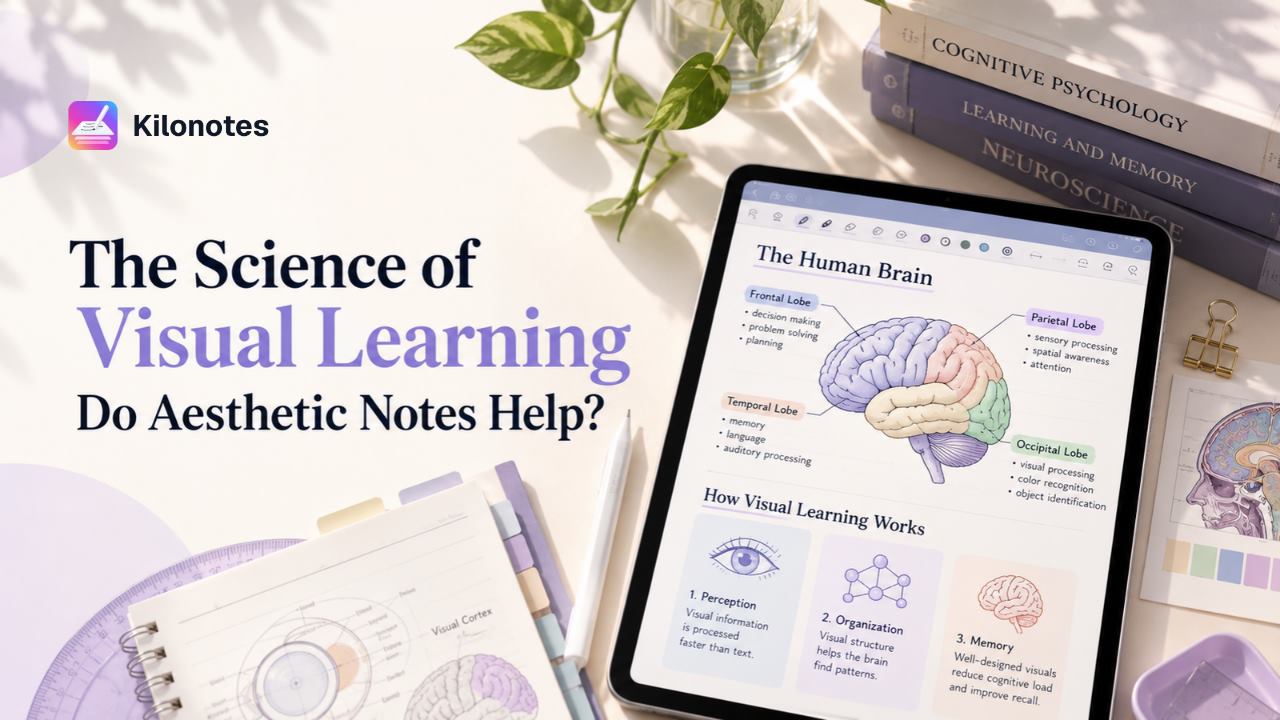
A page of neatly arranged notes can make a difficult subject feel more approachable. Headings stand out, diagrams have room to breathe, and you can find the definition you need without reading every line.
But does that mean aesthetic notes actually help you learn?
The useful answer depends on what the design is doing. A layout that makes relationships clearer can support understanding. Spending an hour decorating a page without thinking about its content is a different activity.
You do not need perfect handwriting or an elaborate color palette. You need a page that helps you see what matters—and gives you something useful to do with it.
Give color a specific job
Imagine a biology page where the name of a structure and its matching label in a diagram share the same color. That visual connection tells you which explanation belongs to which part.
Researchers call this kind of guidance signaling. A meta-analysis of multimedia learning studies found that signals highlighting relationships between text and pictures improved comprehension and transfer on average, particularly for learners with less prior knowledge. That supports purposeful visual cues; it does not establish that any colorful page improves memory. Richter, Scheiter and Eitel, 2016.¹
A practical starting point is three roles:
- One color for key concepts.
- One for examples or applications.
- One for questions you still need to resolve.
Keep ordinary text dark and readable. If everything is highlighted, the page stops telling you what deserves attention.
Let the layout show the structure
Before choosing stickers or fonts, decide how the information fits together.
A comparison belongs in a table. A sequence needs numbered steps or a flow diagram. An argument needs a clear distinction between the claim, supporting evidence, and objections.
For example, a psychology page comparing two theories could use the same four headings for each: main idea, supporting evidence, limitations, and application. That gives you a direct comparison instead of two disconnected paragraphs.
White space also has a practical role. Leave room beside a difficult concept for a later explanation, worked example, or correction.
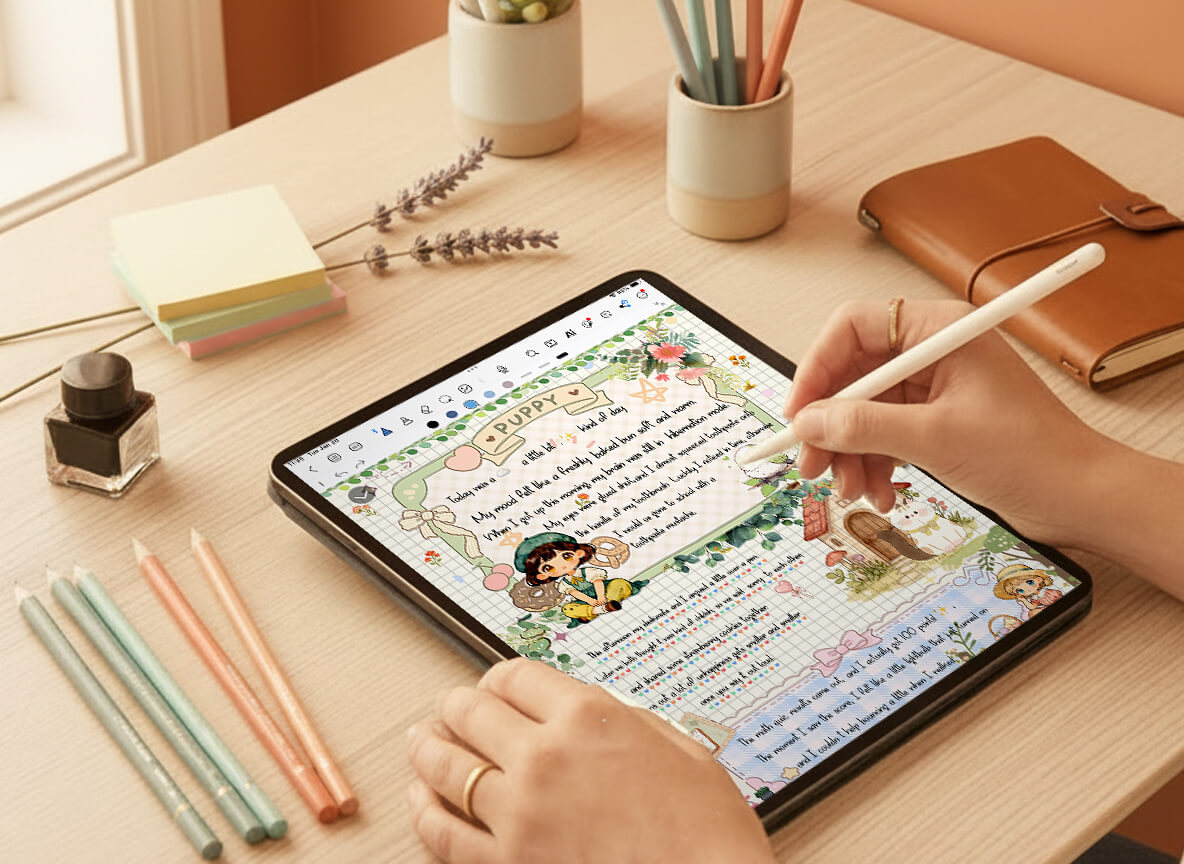
Choose visuals that explain something
A useful diagram should answer a question.
Which stages lead to the next? How do these concepts connect? Where does this example fit within the larger topic?
Try drawing a process from memory, then checking it against your source. The missing labels and uncertain arrows show you what to revisit. A copied diagram may look complete even when your understanding is not.
You can still enjoy decorative details. Give them a time limit so that arranging the page leaves enough time to study it.
Turn the finished page into a test
Once your notes are clear, cover a section and explain it without looking. Answer the questions you placed in the margin. Recreate a comparison table on a blank page.
Research on retrieval practice shows that recalling information can improve later retention. A well-designed page becomes more valuable when it supports that process. Roediger and Karpicke, 2006.²

Build a style you can maintain
Choose one heading style, a small color palette, and a repeatable layout. Use them across a week of lectures before adding anything else.
Kilonotes offers custom fonts and study templates that can help you maintain a consistent appearance. Start with one topic and judge the result by how easily you can use it during revision. Explore Kilonotes’ aesthetic note-taking features.³
Footnotes
¹ Source: Richter, J., Scheiter, K., & Eitel, A. (2016). “Signaling text-picture relations in multimedia learning: A comprehensive meta-analysis.” Educational Research Review, 17, 19–36. https://www.sciencedirect.com/science/article/pii/S1747938X15000664
² Source: Roediger, H. L., & Karpicke, J. D. (2006). “Test-Enhanced Learning: Taking Memory Tests Improves Long-Term Retention.” Psychological Science, 17(3), 249–255. https://www.psychologicalscience.org/journals/psychological-science/j.1467-9280.2006.01693.x/
³ Source: Kilonotes. “Aesthetic notes.” Accessed 21 October 2026. https://www.kilonotesapp.com/en/aesthetic-notes