Try typing a triple integral. Go on — open a text editor and reproduce a line of real analysis, with the limits, the differentials and a couple of Greek letters. It takes maybe forty seconds. Writing it by hand takes four.
That ratio is the entire problem with STEM note-taking, and it's why the standard advice to "just type your notes" collapses the moment you leave the humanities. Mathematical notation isn't linear text. It's spatial — superscripts, fractions, matrices, symbols stacked above and below a bar — and keyboards were designed for sentences.
So STEM students end up in an awkward position: handwriting is the only realistic way to capture the material at lecture speed, but handwritten notes are the hardest to search, reorganise and revise from. This guide covers how to get both.
Buried in a high-volume programme generally? Our guide on how to survive your first year of medical school covers the wider system this fits into.
Why handwriting wins for STEM specifically
There is a general case for handwriting: writing by hand is slower, which forces you to process rather than transcribe. An influential 2014 study found this produced better conceptual understanding than typing,¹ though a large 2021 direct replication did not reproduce that learning advantage — the reduction in verbatim copying replicated, the exam-performance gain did not.² Treat the general claim as suggestive rather than settled.
But in STEM the case is stronger, for three reasons that have nothing to do with cognitive processing.
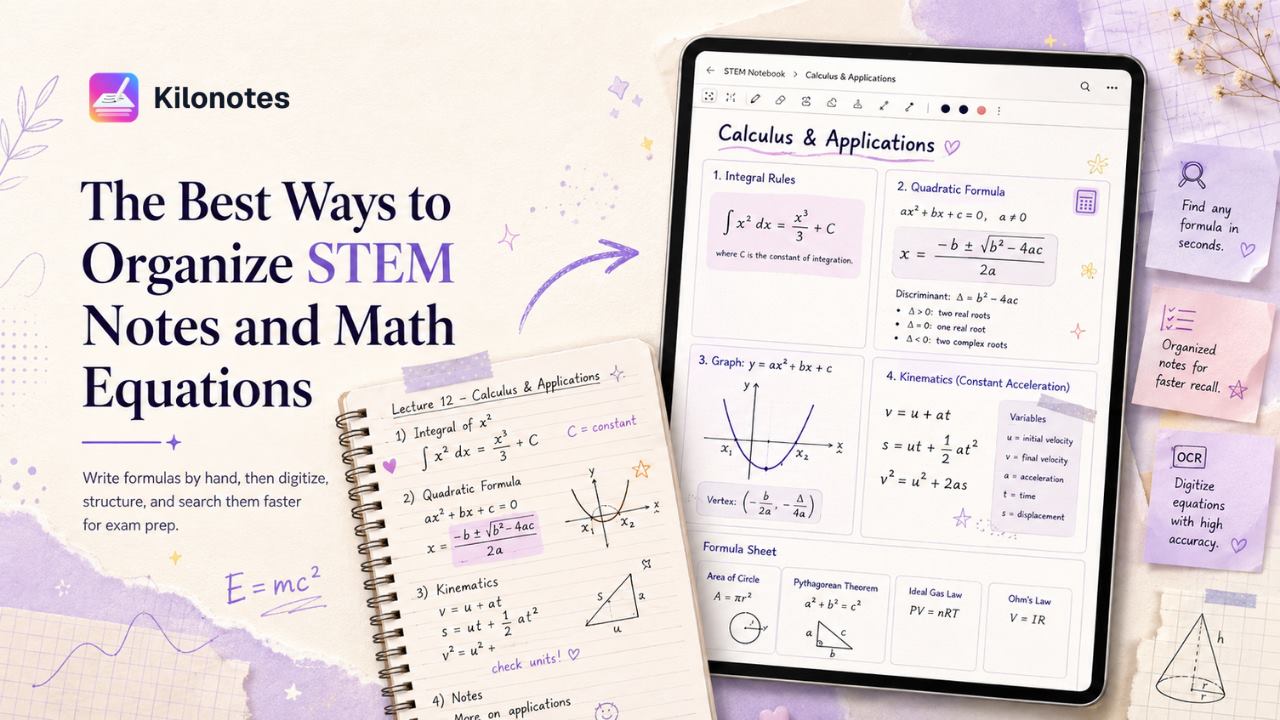
Notation is two-dimensional. A limit sits under the operator. An exponent sits above the line. A matrix is a grid. Handwriting represents this natively; a keyboard requires you to translate it into an equation editor and back.
Diagrams are the argument. A free-body diagram, a reaction mechanism, a circuit, a phase portrait — in most STEM subjects the drawing carries meaning that prose cannot. You cannot type these at any useful speed.
Working is the content. In mathematics the derivation matters as much as the result. You need to record a chain of steps with arrows, annotations and crossings-out — a fundamentally handwritten format.
The conclusion isn't "go back to paper." It's that your digital system has to accommodate handwriting as a first-class input rather than treating it as a fallback.
Structure the page before the lecture starts
Most STEM notes fail at the layout stage, not the content stage. Three habits fix the majority of it.
Split the page. Keep a wide left column for the main derivation and a narrower right margin for commentary — why this step is legal, where the lecturer said this appears in the exam, what confused you. Mixing the two into one stream is what makes notes unreadable in April.
Give every result a name. Box or label anything you'll need to refer back to. "By (3.2)" is only useful if something is labelled 3.2. This is trivial in the moment and enormously valuable in revision.
Write the assumptions down. The most common gap in STEM notes is a theorem recorded without its conditions. Six weeks later you have a formula and no idea when it applies, which is worse than not having it.
The organisation system
Beyond the page, you need a structure across the module. What works is boringly consistent.
One notebook per module, chronological. Not per week, not per topic. Lectures arrive in an order that reflects how the subject builds, and preserving that order preserves the logic.
A separate problem-set section. Worked problems are a different kind of artefact from lecture notes and you'll want them separately at revision time. Keep them in the same notebook but clearly divided.
A running formula sheet. Start one in week one and add to it as you go. Building it at the end is a chore; building it continuously is nearly free and doubles as spaced review.
An error log. Every problem you got wrong, with the specific reason. This is the single highest-value document in a STEM module and almost nobody keeps one — your mistakes are far more diagnostic than your successes.
Making handwritten maths searchable
Here's where the digital advantage finally arrives, and where most tools disappoint.
Generic handwriting recognition treats everything as words. Point it at an integral and it produces a meaningless string of characters, because it has no model of mathematical structure. A tool that genuinely handles STEM recognises notation as notation — preserving the relationship between a numerator and denominator, an exponent and its base.
This matters practically because of what it enables: searching your own working. In a module with twelve problem sets, being able to find every place you used a particular substitution turns a pile of paper into a queryable archive. And that in turn makes self-testing frictionless — which matters, because practice testing and spaced practice are the two techniques cognitive research rates as high-utility across essentially every subject and learner.³
Two features to insist on:
Maths recognition specifically, not just handwriting recognition. Check it against a real equation from your own notes before committing.
Non-destructive conversion, so the searchable text sits alongside your original handwriting rather than replacing it. Your diagrams and layout carry meaning you don't want to lose.
For the mechanics of how handwriting recognition works and what separates good implementations from poor ones, see our guide on how to convert handwriting to text quickly and accurately.
A note on code
If you're in computer science, keep concepts and code in different places. Handwriting is excellent for algorithms, complexity arguments, data-structure diagrams and pseudocode — the conceptual layer. It is a poor medium for actual source code, which belongs in an editor where it can be compiled and run.
The mistake is trying to make one tool do both. Sketch the algorithm by hand, implement it in an IDE, and link the two rather than merging them.

Putting it into practice
The system above needs a tool that treats handwriting and mathematics as primary rather than as an afterthought.
Kilonotes handles this directly: handwriting converts to editable text with maths equations recognised, and both the original handwriting and the converted text stay in the same document.⁴ You can write with an Apple Pencil or S Pen, draw diagrams and mechanisms on the same page as the working, annotate problem-set PDFs, and search handwriting across every notebook — so finding a substitution from week three is one query rather than an afternoon.
The pipeline also runs the other way: AI recap pulls key points out of lecture recordings and PDFs, and generates outlines and mind maps from raw notes, which is a fast way to build that running formula sheet without transcribing it manually.
Ready to make your equations searchable? Download Kilonotes free and test it on your messiest derivation — that's the honest benchmark.
Footnotes
¹ Source: Pam A. Mueller and Daniel M. Oppenheimer, "The Pen Is Mightier Than the Keyboard: Advantages of Longhand Over Laptop Note Taking." Psychological Science, 2014;25(6):1159-1168. https://journals.sagepub.com/doi/abs/10.1177/0956797614524581
² Source: Heather L. Urry et al., "Don't Ditch the Laptop Just Yet: A Direct Replication of Mueller and Oppenheimer's (2014) Study 1 Plus Mini Meta-Analyses." Psychological Science, 2021;32(3):326-339. https://journals.sagepub.com/doi/10.1177/0956797620965541
³ Source: John Dunlosky, Katherine A. Rawson, Elizabeth J. Marsh, Mitchell J. Nathan and Daniel T. Willingham, "Improving Students' Learning With Effective Learning Techniques: Promising Directions From Cognitive and Educational Psychology." Psychological Science in the Public Interest, 2013;14(1):4-58. https://journals.sagepub.com/doi/abs/10.1177/1529100612453266
⁴ Source: Kilonotes, "How to Convert Handwriting to Text Quickly and Accurately." https://www.kilonotesapp.com/en/blog/how-to-convert-handwriting-to-text