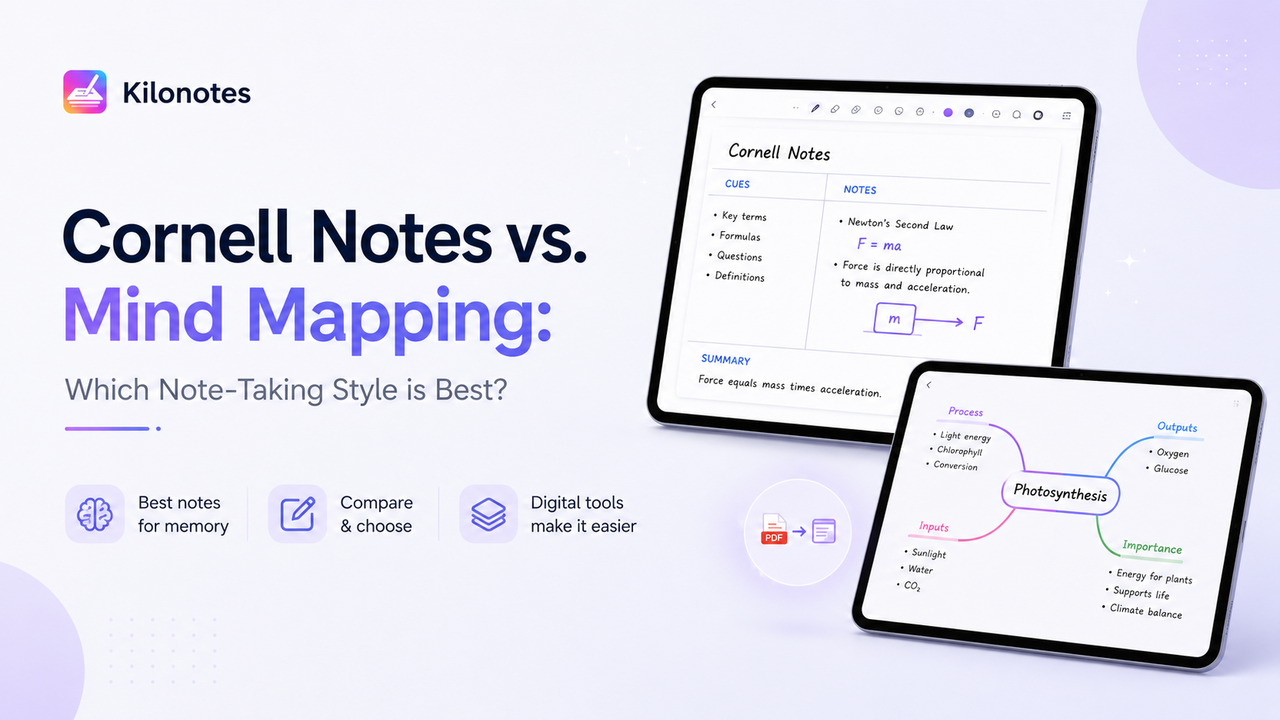
Walk into any university lecture hall and you will see two distinct tribes of students. On one side, you have the structured linear purists, neatly formatting their pages into organized columns. On the other side, you have the visual architects, drawing colorful webs of interconnected ideas.
When it comes down to the classic academic showdown of cornell notes vs mind mapping, which style actually reigns supreme?
The short answer is: it depends entirely on what your brain is trying to process. Both frameworks are titans of visual note taking, but they serve fundamentally different types of information. Let's break down how to pair each method with your college course load to build the best notes for memory and retention.
Cornell Notes: The King of Linear Logic
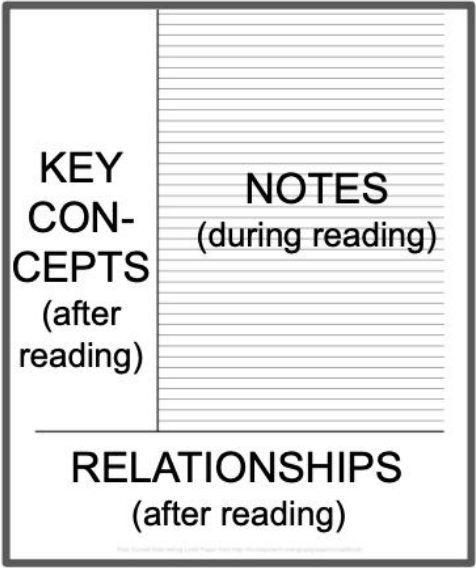
The Cornell system is all about structure, discipline, and systematic review. By carving up your page into separate sections for Cues, Notes, and a Summary, it forces you to actively process lectures in real-time.
Why it Triumphs in STEM Courses
If your semester is packed with heavy STEM (Science, Technology, Engineering, and Math) courses, Cornell notes should be your go-to framework. Classes like Calculus, Organic Chemistry, Physics, or Computer Science don't usually move in abstract circles—they move in a straight, logical line.
- Sequential Processing: STEM requires step-by-step problem-solving. The main notes column lets you write down formulas, derivations, and code snippets chronologically.
- The Cue Advantage: You can use the left-hand column to isolate specific variables, laws, or functional groups, allowing you to quickly flashcard-quiz yourself later without rewriting your material.
Mind Mapping: The Radiant Web
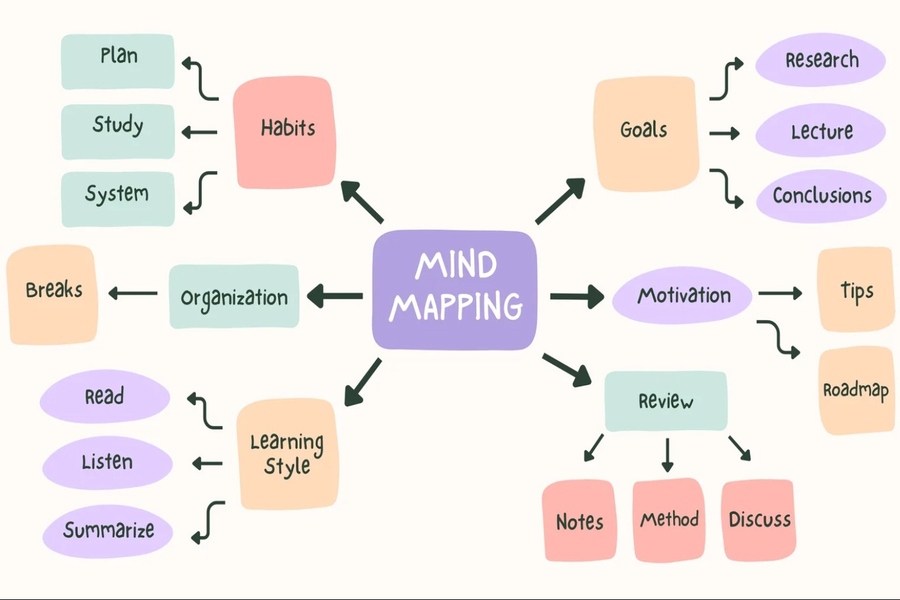
If Cornell notes are a structured highway, mind mapping is a roundabout with a dozen different exits. You start with a core concept right in the center of your page and radiate outward, connecting secondary and tertiary ideas with branches, symbols, and colors.()
Why it Reigns in the Humanities
Humanities and liberal arts subjects—think Literature, History, Philosophy, and Political Science—thrive on thematic overlaps rather than linear timelines.
- Capturing Interconnected Themes: When analyzing a Shakespearean play, a single character web connects to political motifs, historical context, and psychological character arcs all at once. A linear outline flattens these connections, but visual mapping preserves them.
- Aiding Macro-Comprehension: A mind map allows you to see the "big picture" of an entire philosophical movement or historical era on a single page, showing you exactly how cause and effect the web outwards.¹
The Battle for Retention: Which Provides the Best Notes for Memory?
Cognitive psychology heavily favors both methods, but for entirely different neurological reasons:
The Cornell Method capitalizes on Active Retrieval Practice. By covering your notes column and trying to answer the prompts in your cue column, you actively pull information out of your brain, which is the single most effective way to strengthen long-term memory pathways.²Mind Mapping leverages Dual Coding Theory. Your brain processes images and text through different mental channels. By combining spatial organization, colors, and keywords, mind mapping forces your brain to build complex cognitive maps rather than just memorizing strings of text.³
So, which creates the superior study guide? If your exam requires you to recall precise definitions, specific formulas, or chronological facts, Cornell wins. If your exam requires you to write comprehensive essays, synthesize broad arguments, or understand complex ecosystems, Mind Mapping takes the crown.
The Digital Revolution: Tablets Make It Effortless
Historically, both of these styles had a major flaw: they were incredibly tedious to maintain on traditional paper.
Drawing perfect Cornell borders at the start of every lecture gets old fast, and there is nothing worse than running out of physical page space halfway through a massive mind map.
Fortunately, the digital era eliminates these physical boundaries entirely. With advanced note-taking applications like Kilonotes, you no longer have to build these complex frameworks from scratch or worry about cramming layouts into finite page dimensions.
By leveraging Kilonotes AI Studio, you can instantly transform recorded audio lectures, imported PDF textbooks, or handwritten session notes into fully structured, comprehensive mind maps. Instead of getting bogged down by manual tracking and structural constraints, you can let intelligent technology instantly organize your knowledge base so you can focus entirely on understanding the material.
This is where modern digital tablet tools completely flip the script. Utilizing an iPad or Android tablet makes adopting both methods significantly faster and easier:
- Infinite Canvases: Digital apps allow you to build sprawling mind maps without ever running out of physical boundaries. If an idea branches off unexpectedly, you just pinch-to-zoom and keep going.
- Instant Templates: Note-taking platforms offer pre-made Cornell layouts with the tap of a button. No rules or manual page prep required.
- Drag-and-Drop Reorganization: Made a mistake in your mapping hierarchy? In the digital world, you can lasso your handwritten text and move it to a completely different branch seamlessly, keeping your notes pristine.
- If you are trying to figure out how these frameworks fit into your broader academic toolkit, check out The Ultimate Guide to Note-Taking Methods for College Students to master other structured strategies.
Quick-Reference Comparison: Cornell vs. Mind Mapping
| Feature | Cornell Notes | Mind Mapping |
| Primary Structure | Linear, column-based | Spatial, non-linear web |
| Best Subject Fit | STEM, Medicine, Law | Humanities, Arts, Literature |
| Core Cognitive Benefit | Active recall & self-quizzing | Dual coding & macro-connections |
| Exam Style Alignment | Multiple-choice, factual, short answer | Essay-based, conceptual, case study |
Finding Your Style
You don't have to pledge exclusive allegiance to one method. The smartest college students adapt their note-taking style to the professor's lecture structure and the subject matter at hand. Experiment with both, leverage your digital tablet tools to cut down organizational friction, and find the perfect balance for your semester.
For more study tips, tech recommendations, and academic hacks, head back to our Homepage.
Footnotes
¹ Source: Paul Farrand, Fearzana Hussain, and Enid Hennessy, "The efficacy of the 'mind map' study technique".() https://www.researchgate.net/publication/11344656_The_efficacy_of_the_'mind_map'_study_technique
² Source: Pam A. Mueller and Daniel M. Oppenheimer, "The Pen Is Mightier Than the Keyboard: Advantages of Longhand Over Laptop Note Taking".() https://journals.sagepub.com/doi/10.1177/0956797614524581
³ Source: Allan Paivio, "Imagery and Verbal Processes". https://www.taylorfrancis.com/books/9781315807231/imagery-verbal-processes-allan-paivio